Community development director, counsel and council members discuss effect of court cases on city’s enforcement
Holding its first meeting of the year, the Solvang City Council on Tuesday, June 12, spent a while talking with staff about how they can properly interpret and enforce the upcoming draft ordinance on city signage.
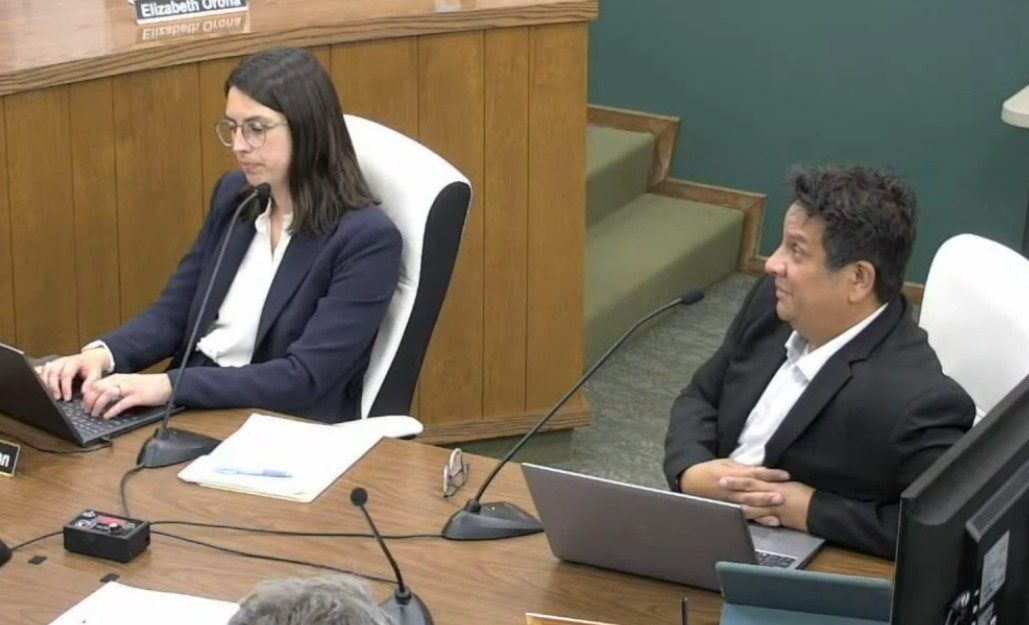
Community Development Director Rafael Castillo introduced the discussion item Discussion and direction on Draft Title 11, Chapter 13 Sign Ordinance Amendments, with the councilmembers seemingly frustrated at times over what they would be able to enforce.
Castillo said in his report the city staff has prepared a working draft of comprehensive, content-neutral sign ordinance amendments intended to modernize regulations, improve legal defensibility, streamline permitting, and preserve Solvang’s character, with the goal of adoption in Spring 2026 alongside a companion sign handbook. He requested City Council direction on:
two key policy issues needed to refine the draft:
The appropriate level of review authority for permanent signs, whether all permanent signage should be approved administratively by staff, remain entirely under Design Review Committee approval, or proceed as currently drafted allowing staff approval of blade/suspended signs only with all other permanent signage reviewed by the DRC.
The maximum amount of permanent signage allowed per business, whether to maintain the proposed cap of up to 20 square feet or building frontage (whichever is less) inclusive of all permanent signage, modify the standard to be based on linear frontage as recommended by the Planning Commission, or provide alternative direction.
Based on Council input, staff will finalize the draft ordinance and return it to the DRC and Planning Commission for formal recommendations prior to City Council adoption.
At its special joint meeting with the Planning Commission on March 13, 2025, city staff received direction on proceeding with proposed sign ordinance amendments. City staff has commenced amending the sign ordinance based on comments and feedback received from the workshop and its November meeting with the City Council.
Staff has taken the draft sign ordinance to the Design Review committee in three sections to receive input and discussion. The DRC discussed the sign ordinance at its June, August, and October meetings of 2025. The
Planning Commission has reviewed a draft of the draft revisions at its November 2025 meeting and provided additional comments on the draft ordinance.
Discussion on City Council was on two points: whether sign approvals would be done by city staff, by the city’s Design Review Committee or approvals would fall under draft ordinance, which allows blade/suspended signs to be reviewed and approved at a staff level, and all other permanent signage needs to be reviewed and approved by the DRC.
The second topic was maximum signage and whether to keep at the current policy that allows a total of 1 square foot of signage per linear feet for “dominant” building
frontage, and ½ square foot per linear feet of “subordinate” square footage for permanent signs, or just have it at a max of 20 square feet.
When Mayor David Brown asked for guidelines on the discussion, Castillo said that review for signage was limited to “time, place, and manner,” but not content, a policy necessitated by Supreme Court cases like Reed v. Town of Gilbert, which protected free speech on signs.
Councilmember Elizabeth Orona than asked “So signs are exempt from color governance?” When Castillo confirmed that they were, she answered, “That’s a big departure. We have a color palette. We have no method to find aesthetic consistency between a sign and building.”
City Counsel Chelsea O’Sullivan explained, “This is a whole other thing in case law. All content restriction is struck down. We’re trying to come up with something realistic.”
Elizabeth Orona wondered if the city design book that’s currently being worked on could leverage sign design to be more consistent
Castillo suggested while they can’t reject anything on content, they can mentioned to prospective business that the designs in the book are “preferred” and people would fall in line with that.
“Anything you can do to streamline is ideal,” Brown replied. “Call it a brand book or preferred methods. If you called it the standards, they would follow.”
Later, during Public Comment, Esther Jacobsen Bates, chair of the DRC, called in by Zoom (though speaking as a private citizen) said she thought all the approvals should fall to the DRC.
She also brought up the subject of murals in town, which she believed were a category unto themselves and should be reviewed by the DRC.
“DRC should be authority on that,” Jacobsen Bates said. “Have shared mural standards, and recognize that not every wall needs to have a mural, and we should review those carefully.”
Ultimately, the council gave direction to determine maximum signage by linear feet, give the DRC authority on the murals, and keep approval authority as it is in the draft ordinance.
Castillo thanked the council and said, “It’s been a long journey and you will see the final draft soon; I should get this in your hands by March.”
The City Council will meet next on Monday, Jan. 26, at 6:30 p.m.